
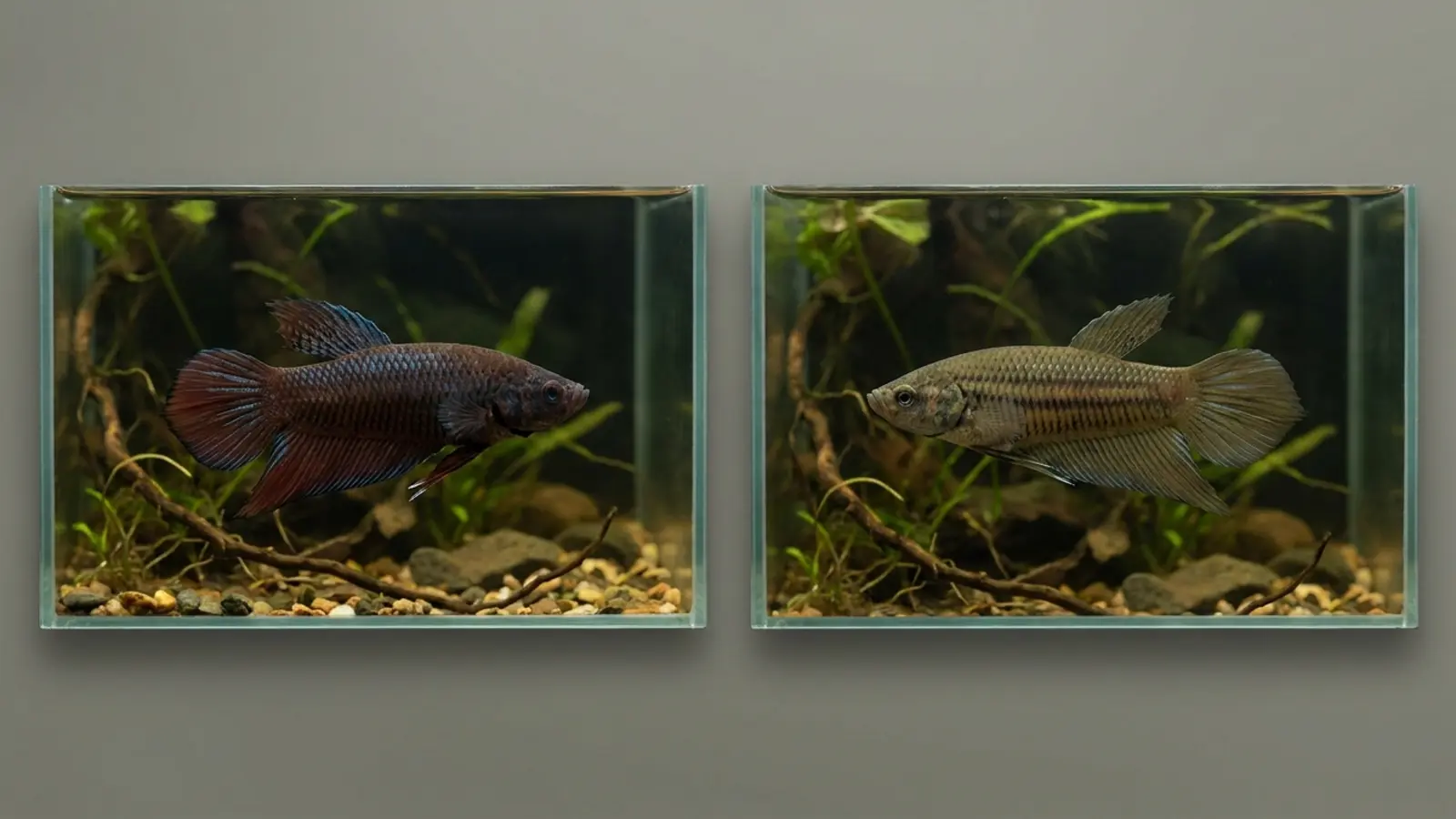
Which traits help distinguish male and female bettas?
| Trait | More common in males | More common in females | Limit |
|---|---|---|---|
| Genital papilla | Usually not prominent | A small pale ovipositor or genital papilla may be visible on the ventral midline | A reflection, fecal material or immature anatomy can be mistaken for an egg spot. |
| Fin form | Many ornamental males have longer dorsal, anal, caudal and pelvic fins | Many females have shorter fins | Plakat males and selected long-fin females overlap. |
| Opercular membrane | Often larger and more visible during a full flare | Usually less prominent | Flaring intensity and viewing angle change visibility. |
| Body profile | Often slimmer outside feeding | A mature female may have a fuller abdomen when carrying ova | Bloating is not a sex marker and requires a health check. |
| Behavior | Territorial display and bubble-nest care are typical male reproductive traits | Females can display and may show vertical breeding bars in context | Behavior varies and should not override anatomy. |
| Genetic sex | Domestic strains commonly use a dmrt1-linked XX/XY system. | Domestic strains commonly use a dmrt1-linked XX/XY system. | The association is not identical across every wild population or domestic cross. |
Do female bettas need different care?
Female and male domestic Betta splendens use the same core aquarium system: stable warm water, appropriate filtration, secure housing, species-appropriate food and routine observation. Sex does not create a separate temperature, water-quality or feeding target. Individual fin form, age, health and behavior can still change how well a particular setup works.
Where sex matters most is identification, reproduction and compatibility. A fish being female does not make cohabitation automatically safe; use the dedicated sorority and tank-mate guides for group-housing decisions.
Are female bettas less aggressive than males?
Female Betta splendens can flare, chase and show aggression, and research has found substantial sex-related and strain-related variation. Sex can influence average behavior in a study population, but it does not predict the temperament of one individual fish.
Do not use female sex as a safety guarantee for another betta. Compatibility should be judged separately, with individual housing available when aggression or persistent stress appears.
Is an egg spot enough to identify a female betta?
A clear genital papilla on a mature fish is useful evidence for a female, but it should be confirmed with body and fin traits. A pale point under the abdomen can be glare, debris or another structure.
Do not squeeze, net repeatedly or restrain a fish to look for the papilla. Observe through clear glass under neutral light and compare photographs over time.
Why are juveniles and Plakat bettas harder to sex?
Juvenile reproductive structures and adult fin differences are not fully developed, so early identification carries more uncertainty. Growth rate also varies with line and rearing conditions; there is no universal age at which every fry becomes easy to sex.
Plakat males naturally have short fins and can resemble females at first glance. In a short-fin fish, combine the genital papilla, opercular membrane, pelvic-fin form, mature body profile and verified reproductive behavior rather than relying on caudal length.
How to identify a betta without causing stress
Confirm maturity and history
Ask for hatch date, parentage and prior identification when available.
Observe the whole fish
Use neutral light and inspect both sides without tapping, chasing or forcing a flare.
Photograph the ventral area
Use a clear side view to look for a genital papilla without handling the fish.
Compare several traits
Record fin form, opercular membrane, pelvic fins, body profile and any known reproductive behavior.
Keep uncertainty in the label
If traits conflict, record probable male or probable female and reassess after maturation rather than forcing a pairing.
Related identification guides
Pairing and fry care
Use a separation-first plan only after identification is sufficiently supported.
Plan breeding safelyFemale sororities
Understand why identifying several females does not guarantee compatibility.
Review cohabitation risksFrequently asked questions
- Do all female bettas have a visible egg spot?
- A genital papilla may be visible in mature females, but size, posture, pigmentation and viewing angle can obscure it. Use more than one trait.
- Can male bettas have short fins?
- Yes. Plakat males have short fins, so short fins do not prove that a betta is female.
- Are male bettas always more colorful?
- No. Domestic females can be highly colored, and color varies more by line and individual than by a universal sex rule.
- Can females flare?
- Yes. Female Betta splendens can display aggression and flare. Flaring does not prove that a fish is male.
- Are female bettas smaller than males?
- Body size and fin proportions overlap across domestic lines, ages and individual fish, so size alone is not a reliable sex marker. Compare several mature traits instead of assuming that a smaller fish is female.
- What types of female bettas are there?
- Female describes sex, not a separate tail, color or species category. Females can occur across many domestic fin forms, colors and patterns, so use those appearance labels separately from sex.
- Can I put two fish together to test their sex?
- No. Introducing territorial fish as a test can cause injury. Identify them through non-contact observation and maintain separate secure housing.
Sources
- The genetic architecture of phenotypic diversity in the Betta fish — Science Advances / PubMed Central
- Care and Use of Siamese Fighting Fish for Research — Journal of the American Association for Laboratory Animal Science / PubMed Central
- Transposon-induced epigenetic silencing in the X chromosome during sex determination — BMC Biology
- Larval Development of Siamese Fighting Fish — Acta Natura et Scientia
- Sex-related and strain-related variation in Betta splendens aggression — Animals / PubMed Central