
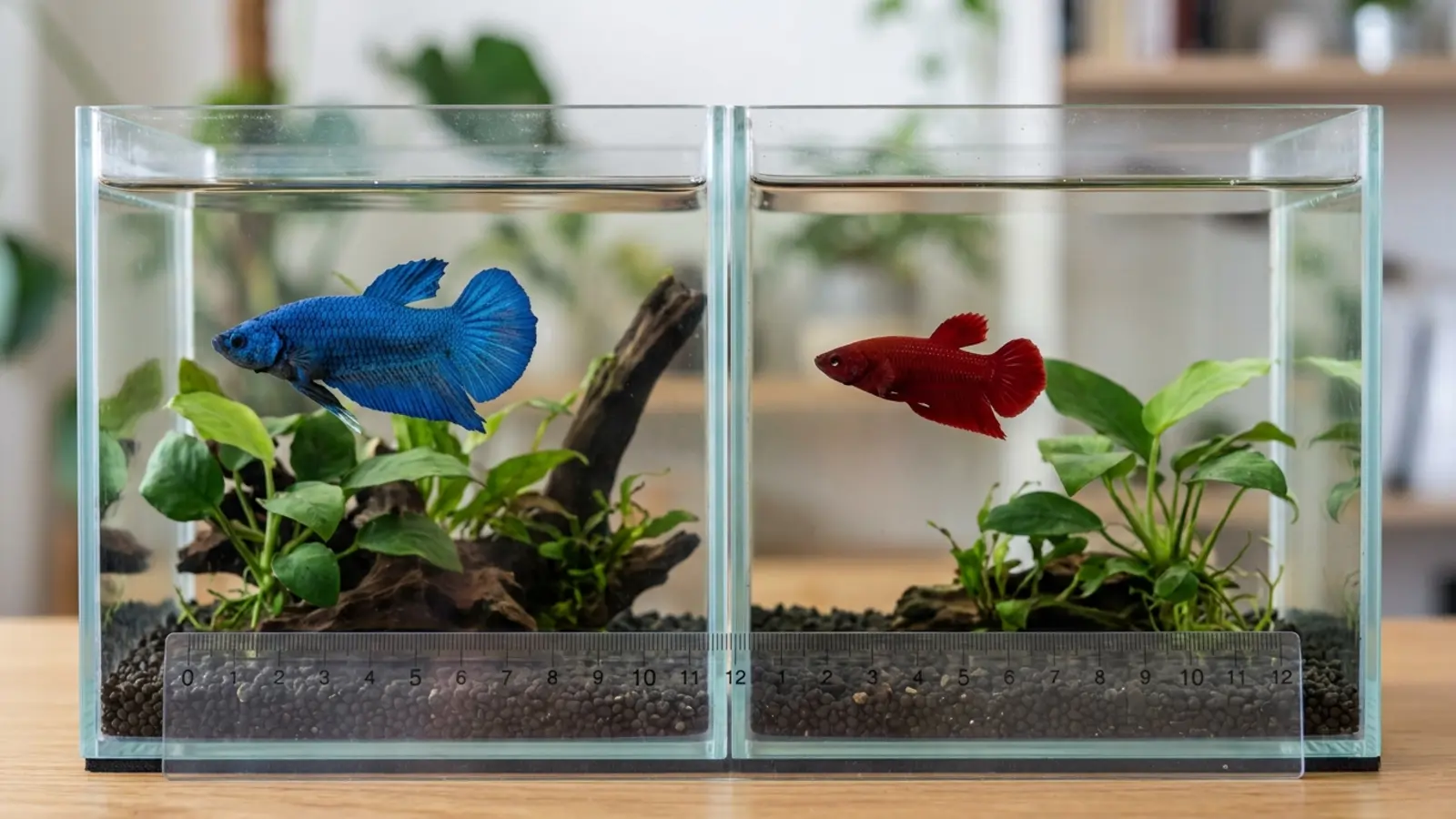
How does a Giant betta differ from a standard betta?
| Question | Best-supported answer | What remains uncertain |
|---|---|---|
| Body size | Research groups classified Giant bettas by significant enlargement in length, body height and weight compared with non-Giant groups. | The studies do not establish one universal inch cutoff for every fish sold as Giant. |
| Genetics | Genome studies found associated signals across more than one genomic region and proposed several candidate genes. | The functional contribution of each candidate and the effect of different breeding lines remain under study. |
| Growth rate | A Giant may grow faster or for longer than a standard-size fish, but growth depends on age, line, sex, nutrition, health and conditions. | No reliable study supports a universal monthly growth increment or exact maturity week. |
| Care planning | A larger fish needs enough horizontal swimming room, accessible surface air and filtration that maintains stable water quality. | Research has not established a separate evidence-based minimum tank volume for every Giant betta. |
How big does a Giant betta get?
Giant bettas are larger on average than standard domestic lines, but an adult cannot be promised to reach exactly 3.5, 4 or 4.5 inches. Research comparisons use measured traits such as standard length, total length, body height and weight. Retail listings may use a different measurement or include the tail.
Record both standard length, from the snout to the base of the tail, and total length, from the snout to the end of the caudal fin. State which measurement you use. This prevents a long-finned fish from appearing larger solely because its tail was included.
What do genetic studies show about Giant bettas?
A study of 54 fighting-fish genomes found three highly differentiated regions on chromosomes 1, 9 and 11 when Giant and non-Giant groups were compared. Brain and muscle transcriptome analysis produced 14 candidate genes associated with the Giant phenotype.
A separate large-scale Betta study also found shared genome-wide signals when Giant status and measured standard body length were analyzed. These findings support a genetic basis for enlarged size, but they do not reduce the phenotype to one confirmed codominant growth-hormone mutation.
What is the difference between a Giant and King betta?
Giant and King are not reliable interchangeable genetic diagnoses. Giant has been used as a phenotype in genomic research, while King is often a trade or form label whose meaning can vary by breeder or seller. A sales label alone cannot confirm ancestry or adult size.
Before buying, ask for the fish's current standard length, age and photos with a scale reference. Parent measurements can add context, but they still cannot guarantee the offspring's final size.
How should you plan a Giant betta aquarium?
A 10-gallon-class aquarium is a conservative planning target for a large Giant-labeled adult, not a biological cutoff. The final setup should match the actual fish and remain stable under testing.
Prioritize horizontal space
Choose a tank footprint that lets the fish turn, reach the surface and swim without crowding from decor. Keep the water level and cover compatible with safe surface breathing.
Cover the aquarium
Use a secure lid because Betta splendens can jump. Leave an appropriate air gap and do not block access to the surface.
Size filtration by test results
Use gentle filtration and track ammonia, nitrite and nitrate. A larger body may increase food intake and waste, but water tests should determine maintenance changes.
Keep temperature stable
Use the accepted domestic-betta temperature range and verify it with a separate thermometer. Giant size does not create a different proven temperature requirement.
Reassess as the fish grows
Measure the fish periodically and check swimming room, turning space, fin condition and water quality. Move to a larger footprint if the current setup restricts normal movement or becomes difficult to keep stable.
What should a Giant betta eat?
A Giant betta needs a complete carnivorous betta diet portioned to the individual fish. A larger body may justify a larger total ration than a smaller adult, but feeding should not be increased simply to force rapid growth.
Use body condition, appetite, waste and water tests to adjust portions. Remove uneaten food. Live or frozen foods can add variety when safely sourced, but they should not replace a balanced staple or be used to chase an advertised adult size.
Related betta guides
Betta diet and feeding
Choose portions by body condition and water quality instead of forcing a growth target.
Review feeding guidanceBetta water parameters
Use test results to decide whether the aquarium and maintenance routine handle the fish's waste.
Review water parametersFrequently asked questions about Giant bettas
- Is a Giant betta a separate species?
- No. Giant describes an enlarged domesticated phenotype of Betta splendens, not a separate Betta species.
- Does every Giant betta reach four inches?
- No. The Giant label indicates selection for larger size but does not guarantee one adult length. Ask whether the stated measurement includes the tail and compare it with the fish's age and current standard length.
- Does a Giant betta need a 10-gallon tank?
- Ten gallons is a conservative planning target for a large adult, not a research-defined threshold. Choose enough horizontal room for the actual fish and confirm that filtration and maintenance keep water chemistry stable.
- Do Giant bettas have shorter lives?
- No reliable evidence establishes an exact two-to-three-year lifespan or proves that Giant size alone shortens life. Line health, water quality, diet, disease and individual care all affect lifespan.
- Can a Giant betta live with tank mates?
- Size does not make a betta community-safe. Temperament varies, and any tank-mate plan needs enough space, compatible conditions, observation and an immediate separation option.
Sources
- The genetic architecture of phenotypic diversity in the Betta fish — Science Advances / PubMed Central
- Whole-genome resequencing infers genomic basis of giant phenotype in Siamese fighting fish — Zoological Research
- Betta Fish Care Sheet — PetMD
- Care and Use of Siamese Fighting Fish (Betta splendens) for Research — Journal of the American Association for Laboratory Animal Science / PubMed Central
- How should I care for my Siamese fighting fish? — RSPCA Australia Knowledgebase