
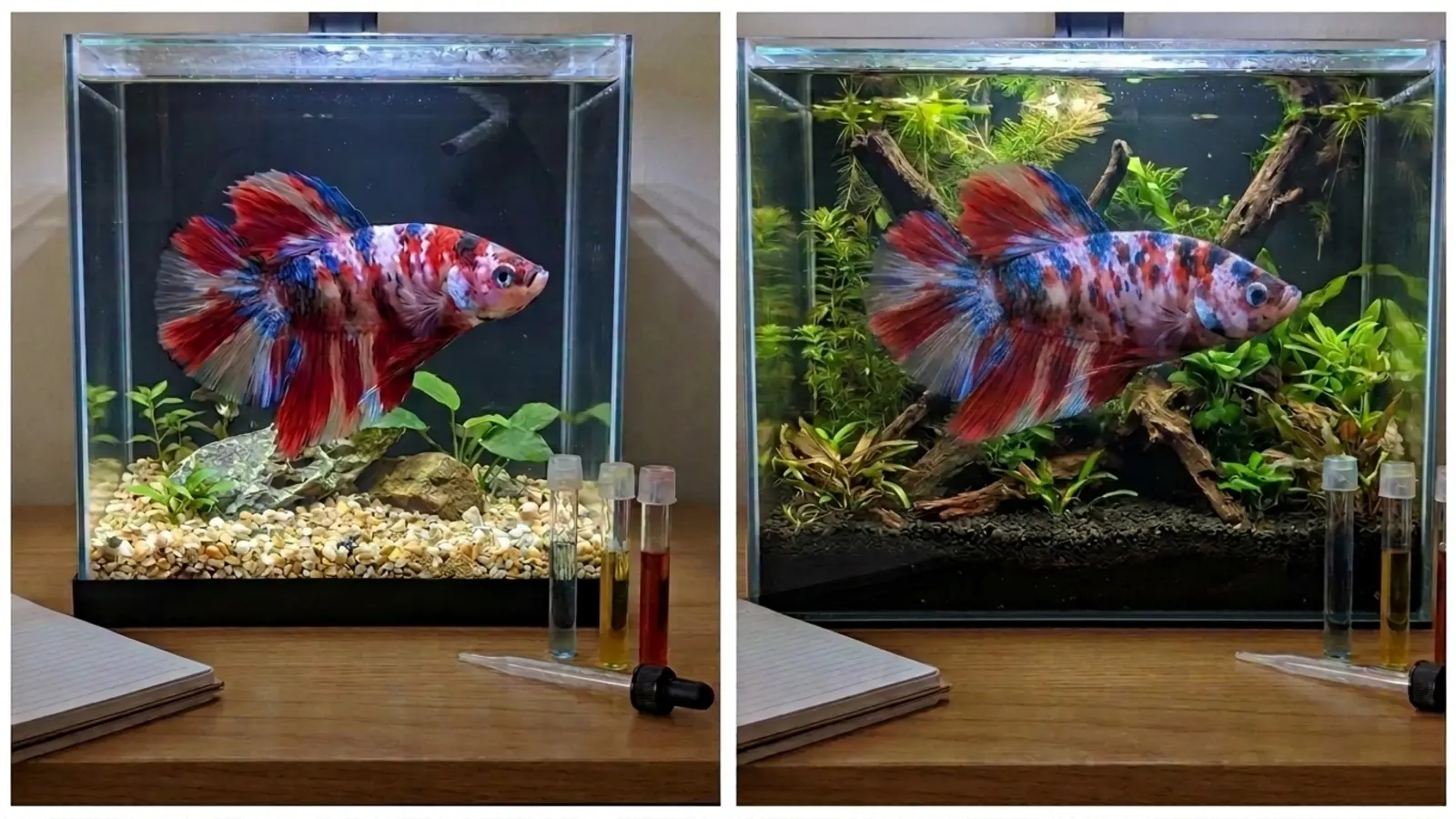
What does the pattern of change suggest?
| Observed change | First checks | Response |
|---|---|---|
| Gradual patch redistribution over weeks or months | Compare dated images under similar neutral light; review whether the fish has marble or koi-like ancestry. | Continue monitoring if appetite, breathing, activity, body condition and water results remain normal. |
| Whole-body fading after a move or equipment problem | Test temperature, ammonia, nitrite, nitrate and pH; confirm filter and heater operation. | Correct measured husbandry problems safely and watch for additional signs. |
| Small pale or dark area after contact with decor | Inspect the tank for sharp or hot surfaces and document the lesion. | Remove the hazard; obtain help if the area grows, reddens or erodes. |
| Gold-brown dust with flashing or breathing change | Treat this as possible external parasitism, including velvet, and seek confirmation. | Do not rely on a flashlight appearance alone or begin a universal copper protocol. |
| White, gray, fuzzy, ulcerated or rapidly expanding patch | Isolate shared equipment, test water and seek prompt professional assessment. | Several bacterial and water-mold conditions can look alike; treatment depends on diagnosis. |
| Color change plus abdominal swelling or raised scales | This is a serious symptom cluster rather than a cosmetic change. | Arrange urgent aquatic-veterinary guidance. |
Can marble-pattern bettas change color normally?
Domestic Betta lines with marble-type patterning can show marked redistribution of pigmented and pale areas over time. Genomic research supports a complex genetic basis for domesticated color and pattern traits, but it does not justify predicting the exact next color of an individual fish.
A normal-looking pattern shift should be gradual and unaccompanied by tissue damage or systemic illness. Dated photographs taken with the same light, angle and camera settings are more useful than memory or two differently lit images.
How to assess a betta color change
Document the timeline
Photograph both sides and record when the change began, how fast it moved and whether the surface is smooth, raised, fuzzy or damaged.
Test the environment
Measure temperature, ammonia, nitrite, nitrate and pH. Verify the heater, filter, water conditioner and recent maintenance history.
Assess the whole fish
Record appetite, respiration, swimming, balance, feces, body shape, fins and any rubbing or clamping.
Check recent changes
List new fish, plants, food, medication, decor, equipment failures and transport events.
Escalate by signs, not color name
Contact an aquatic veterinarian when the change is rapid, progressive or accompanied by breathing difficulty, wounds, swelling or loss of function.
Can food or lighting restore betta color?
A complete diet supports normal pigmentation, but no food can guarantee a particular hue or reverse disease. Avoid overfeeding and products that promise a permanent color transformation.
Neutral, consistent aquarium lighting makes comparisons more reliable. Stronger or longer lighting can change the photograph and increase algae without treating the reason for a color change.
Related checks
Betta colors and patterns
Review the terminology used for domestic color and pattern forms.
Compare color termsWater parameters
Check the measurements that can accompany sudden behavioral or color change.
Test water conditionsDisease symptom matrix
Compare visible signs without treating one feature as a diagnosis.
Review symptom patternsFrequently asked questions
- Why is my betta turning white?
- White or pale change can reflect domestic pattern development, viewing conditions, injury, water-quality stress or disease. Test the water, compare dated photographs and look for texture, breathing, appetite and behavior changes before deciding what it means.
- Can a healthy betta change color more than once?
- Yes. Some marble-pattern domestic bettas change the distribution of pigmented areas repeatedly. Repeated change is not proof of health, so continue routine water testing and whole-fish observation.
- Do stress stripes diagnose poor water quality?
- No. Horizontal barring can occur in several contexts and is especially associated with some females and juveniles. Use measured water results and other signs rather than diagnosing from stripes alone.
- Should I medicate a betta that is only changing color?
- Do not medicate from color alone. Unnecessary treatment can add toxicity, damage the biofilter and obscure the diagnosis. Obtain professional guidance when the change is rapid or accompanied by illness signs.
- How often should I photograph the change?
- A weekly photograph is usually enough for a gradual cosmetic shift. Photograph sooner when the area changes rapidly, develops texture or appears with breathing, balance, appetite or tissue problems.
Sources
- Management of Aquarium Fish — MSD Veterinary Manual
- Routine Health Care of Fish — MSD Veterinary Manual
- The genetic architecture of phenotypic diversity in the Betta fish — Science Advances / PubMed Central
- Parasitic Diseases of Fish — MSD Veterinary Manual
- Bacterial Diseases of Fish — MSD Veterinary Manual
- The genetic basis of the Betta fish domestication process — Science Advances / PubMed Central