
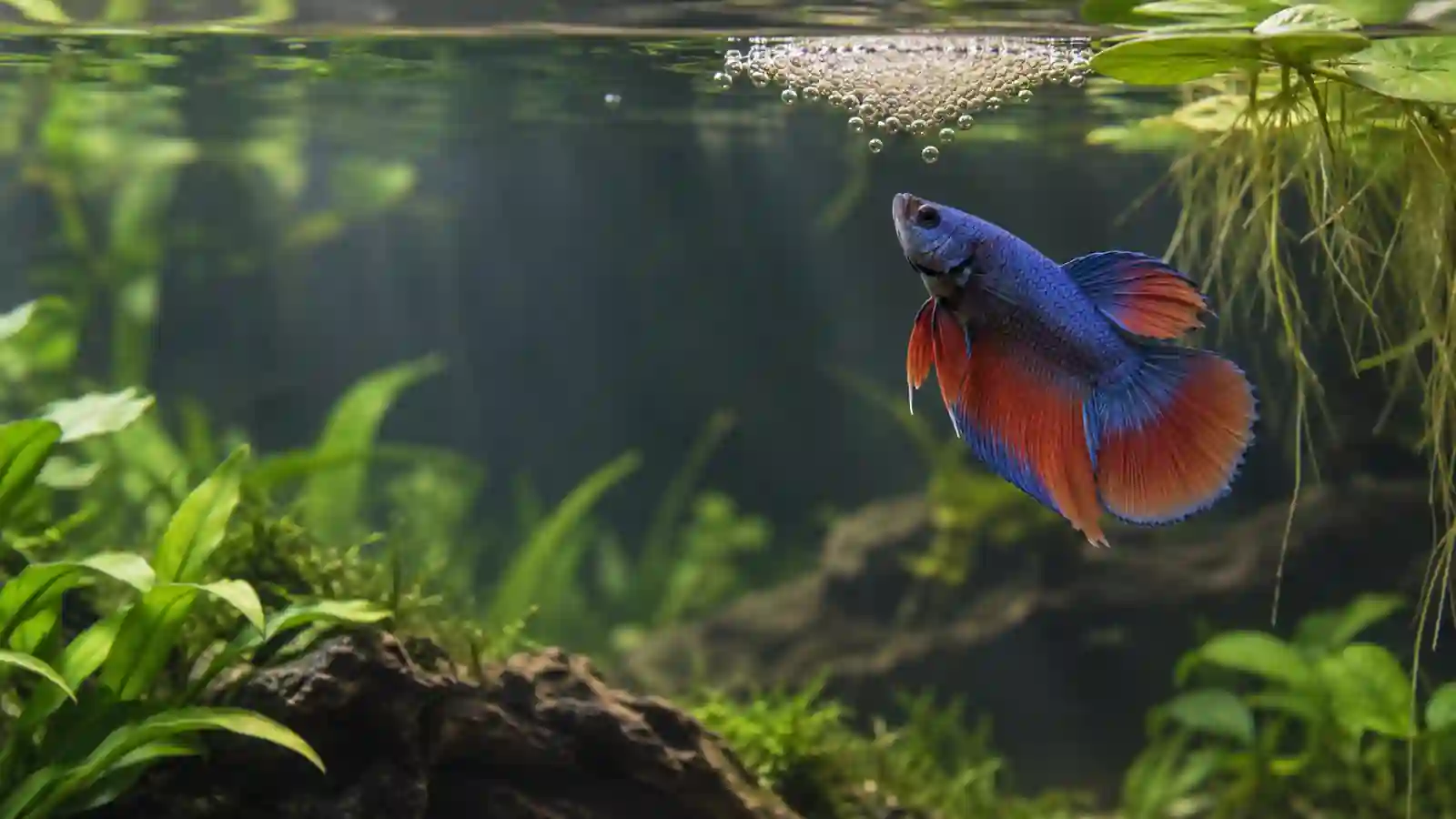
What is a betta bubble nest?
Male Betta splendens produce clusters of bubbles at the water surface as part of their reproductive biology. The bubbles are stabilized with mucus rather than being ordinary trapped air.
A study of the Betta pharyngeal organ found that the bubble-nest material is rich in glycoproteins and that males have a larger pharyngeal organ with more mucus-producing goblet cells than females. That anatomy helps explain how males produce the mucus used in nest construction.
Why do male bettas build bubble nests?
The main biological role is reproduction and paternal care. Before and during spawning, a male builds and maintains a surface nest. After eggs are released and fertilized, the male retrieves many fallen eggs and places them into the nest, then continues tending eggs and newly hatched larvae.
Bubble nesting is one reproductive strategy within the Betta genus. Other Betta species use mouthbrooding, so bubble nesting should not be generalized to every species in the genus.
Can a betta make a bubble nest without a female?
Yes. Male bettas can build nests in their individual home tanks without a female being physically present. Researchers who maintain breeding colonies report that some males build nests before pairing, although the presence of a nest is not required for every successful mating.
That means a nest can reflect reproductive behavior without meaning that the fish needs a mate. A pet betta does not require breeding for good welfare.
Does a bubble nest mean a betta is happy or healthy?
No single behavior can establish that. Bubble nesting can occur under different housing conditions, and individual fish vary in how often they build nests. A nest should not override evidence from water testing, feeding, swimming, breathing, resting, fin condition and other observable behavior.
The reverse is also important: a betta that is not building a nest is not automatically sick, stressed or poorly cared for. Do not change temperature, pH or other husbandry variables simply to force nest production.
What happens to eggs in a bubble nest?
During normal spawning, eggs are fertilized externally and fall through the water. The male retrieves many of them and places them into the bubble nest. Eggs and newly hatched larvae can remain associated with the nest while the male performs paternal care.
If you are intentionally breeding bettas, egg care is only one part of a much larger welfare plan involving separate adult housing, supervised pairing, first foods, water-quality control and space for growing juveniles. Follow the dedicated breeding guide rather than using this article as a breeding protocol.
Why did my betta stop making bubble nests?
Nest-building frequency can vary among individuals and across circumstances. A change in nest building by itself does not identify a cause. Avoid diagnosing illness or poor welfare from the missing nest alone.
Instead, check the aquarium baseline: stable water conditions, normal feeding, ordinary swimming and resting, unobstructed surface access and the absence of persistent abnormal signs. If the fish also shows appetite loss, breathing difficulty, abnormal swimming, injury or another concerning change, use the appropriate health guidance rather than trying to stimulate nest building.
Related guides
Breeding and fry care
Use the welfare-first breeding guide for pairing, spawning, separation and fry care.
Review breeding guidanceWater parameters
Check the aquarium baseline instead of using a bubble nest as a water-quality test.
Review water parametersBehavior and welfare changes
Use broader observable signs when a betta's behavior changes.
Review behavior checksFrequently asked questions
- Does a bubble nest mean my betta wants to mate?
- It is a reproductive behavior, but a nest does not mean you need to provide a mate. Male bettas may build nests while housed alone.
- Is a big bubble nest better than a small one?
- Do not use nest size as a health, happiness or fertility score. Nest characteristics vary, and research does not support turning size into a simple welfare ranking.
- Should I remove a bubble nest?
- There is usually no need to remove a harmless surface nest just because it is present. Normal maintenance and water quality remain more important than preserving or destroying the nest.
- Why is my betta not making bubble nests?
- Some males build nests more often than others, and behavior can change with context. Absence of a nest alone is not a diagnosis. Judge the fish by its broader behavior, physical condition and husbandry.
Sources
- Care and Use of Siamese Fighting Fish (Betta splendens) for Research — Journal of the American Association for Laboratory Animal Science / PubMed Central
- The pharyngeal organ in the buccal cavity of the male Siamese fighting fish, Betta splendens, supplies mucus for building bubble nests — Zoological Science / PubMed
- Life beyond a jar: Effects of tank size and furnishings on the behaviour and welfare of Siamese fighting fish — Animal Welfare / PubMed Central
- Evolutionary transitions between bubble nesting and mouthbrooding in Betta — Journal of Evolutionary Biology / PubMed
- Reproductive strategies of domestic Betta splendens as a foundation for developing breeding programs for Indonesia's endangered wild species — Animal Reproduction Science / PubMed