
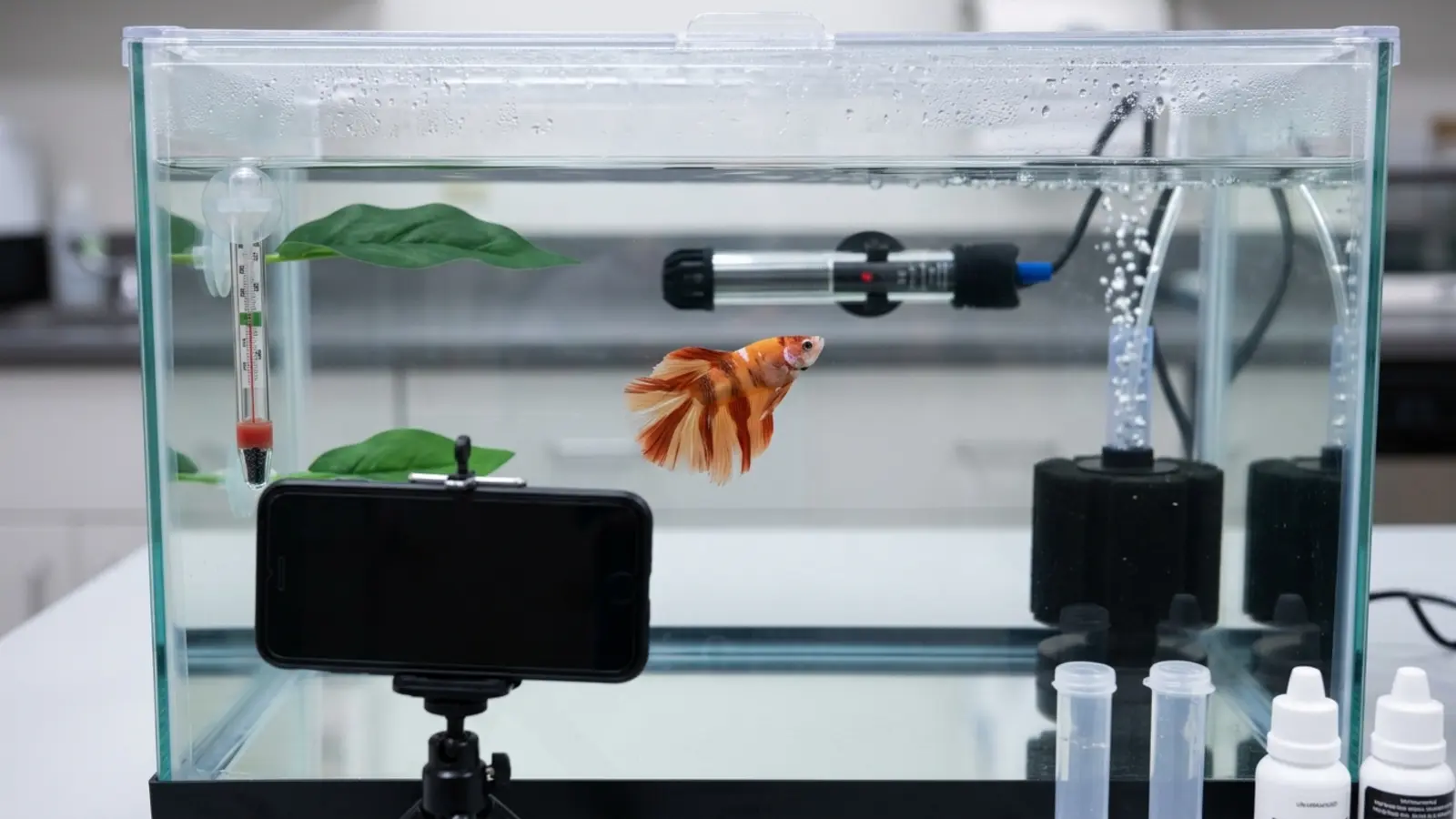
What can cause a betta to float or sink?
| Pattern | Possible categories | Useful evidence |
|---|---|---|
| Floats or tips after feeding | Temporary gastrointestinal distension, overfeeding or swallowed air | Meal size, food type, abdominal profile and whether the sign resolves. |
| Persistent sinking or floating | Gas-bladder dysfunction, chronic organ disease, mass, deformity or injury | Duration, age, body symmetry, imaging and clinical examination. |
| Rolling with rapid breathing | Severe systemic disease, water-quality injury or neurologic dysfunction | Immediate water results, gill rate, exposure history and professional examination. |
| Buoyancy change with swelling | Fluid imbalance, infection, reproductive or organ disease | Top and side photographs, scale position, appetite and feces. |
| Sudden change after trauma | Physical injury or internal damage | Known impact, entrapment, filter intake or handling event. |
| Several fish affected | Shared water-quality, toxic, infectious or gas-supersaturation problem becomes more likely. | Test the system and contact a fish-health professional. |
How should a buoyancy problem be assessed?
Test the environment
Measure temperature, ammonia, nitrite, nitrate and pH; verify heater, filter and aeration operation.
Record the exact movement
Video whether the fish floats, sinks, lists, rolls, struggles after effort or rests normally between episodes.
Review food and output
Record the last several meals, portion changes, feces and abdominal shape without assuming constipation.
Reduce physical demands
Provide calm water, unobstructed surface access and safe resting points while maintaining heat and water quality.
Escalate persistent or severe signs
Share videos, measurements and history with an aquatic veterinarian; ask whether imaging, microscopy or other diagnostics are indicated.
Should every floating betta be fasted?
No. A short feeding pause may be part of a plan when recent overfeeding and temporary abdominal distension are plausible, but universal multi-day fasting can delay care for infection, injury, fluid accumulation or another internal problem.
Do not feed peas as a default remedy. Bettas are insectivorous-carnivorous fish, and a pea does not diagnose or correct every cause of buoyancy loss. A clinician may recommend an appropriate food, portion or fasting interval after reviewing the case.
How can the aquarium be made safer during recovery?
Keep the fish in a heated, covered and biologically managed system with gentle flow. Add broad smooth resting surfaces at several heights and remove sharp objects or narrow gaps.
A modestly reduced water depth may help a fish reach the surface, but a tiny unfiltered container creates new temperature and waste risks. Change depth only while preserving stable heat, oxygenation, filtration and sufficient horizontal movement.
Related health checks
Dropsy signs
Treat buoyancy loss with swelling or raised scales as an urgent symptom cluster.
Review swelling signsBetta diet
Review portion control without turning food into a universal treatment.
Review routine feedingWater parameters
Measure environmental causes before changing medication or temperature.
Test the aquariumFrequently asked questions
- Is swim bladder disease one disease?
- No. The phrase is commonly used for a visible buoyancy problem that can have digestive, infectious, traumatic, developmental or internal causes.
- Why is my betta floating on its side?
- Side-floating can follow temporary distension, gas-bladder dysfunction or serious systemic disease. Test the water and assess breathing, swelling, appetite, feces and duration rather than assuming one cause.
- Will daphnia cure a swim bladder problem?
- Daphnia may be an appropriate food in some feeding plans, but it does not treat infection, trauma, a mass or gas-bladder damage. Do not use one food as a diagnostic test.
- Should I move the fish to shallow water?
- Shallower water can reduce effort for selected fish, but only if temperature, oxygenation, filtration and water quality remain stable. Use a clinician's plan for a severely impaired fish.
- Can a veterinarian treat a damaged swim bladder?
- Depending on the cause, a veterinarian may use examination, imaging, medical care or, in selected larger fish, gas-bladder procedures. MSD describes gas-bladder repair as a surgical veterinary option.
Sources
- Management of Aquarium Fish — MSD Veterinary Manual
- Routine Health Care of Fish — MSD Veterinary Manual
- Providing a Home for Fish — MSD Veterinary Manual